AI Agents vs Traditional Apps: What the Next Generation of Software Looks Like
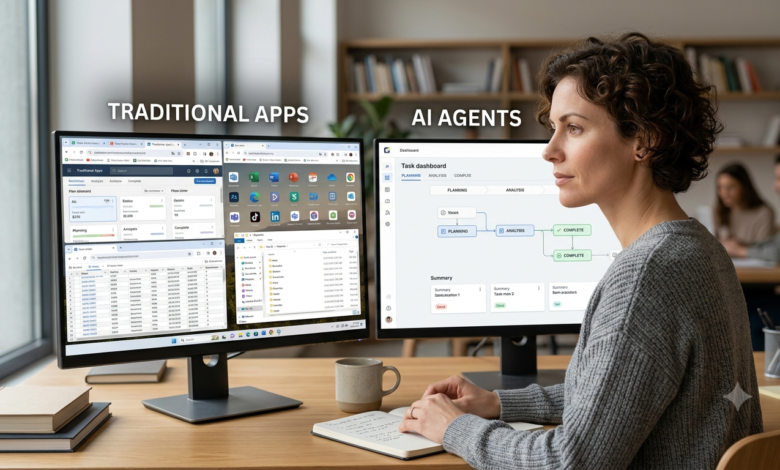
For over three decades, our interaction with software has remained fundamentally unchanged. Whether opening a desktop program, navigating a mobile app, or managing an enterprise dashboard, the underlying interaction paradigm has been command-and-click. Users act as the engine: navigating menus, clicking buttons, entering data, and manually stringing together multi-step workflows.
A quiet but profound paradigm shift is underway. Software is evolving from passive tools that await human commands into autonomous systems capable of understanding high-level objectives, formulating multi-step plans, and executing complex workflows independently. The core debate shaping modern software design is AI agents vs traditional apps.
Understanding this shift requires moving past basic chatbots and simple automated scripts. Agentic software represents a fundamental transformation in how digital technology is built, operated, and experienced.
What Are Traditional Applications?
Traditional applications are deterministic, rule-based software systems designed around explicit human control. They function on explicit instructions: when a user clicks a button, fills out a form, or triggers a keyboard shortcut, the application executes a hardcoded series of operations programmed directly into its codebase.
User Input (Click / Touch / Form) ---> Hardcoded Logic / Rules ---> Deterministic Output
Key Characteristics of Traditional Apps
-
Interface-Driven: Interaction relies heavily on visual UI elements such as drop-down menus, navigation bars, forms, and buttons.
-
Predictable Execution: Given the exact same input, a traditional app will produce the exact same output every single time.
-
Rule-Based Routing: Logic follows rigid conditional statements (
IF / THEN / ELSE). They cannot process inputs or exceptions outside their coded scenarios. -
User-Dependent Workflows: The software executes single operations, but the overall multi-step workflow requires continuous human oversight and manual orchestration.
For example, when booking a business trip using traditional apps, you must open a travel application, filter dates, select flights, enter personal and payment information, switch to a calendar app to block off the time, and open an expense management application to upload the receipt. The apps handle individual steps, but you serve as the connective tissue coordinating the process.
What Are AI Agents?
An AI agent is an autonomous software system that uses machine learning and natural language processing to achieve specific goals with minimal human intervention.
Rather than waiting for point-by-point instructions, an agent receives an overall objective, assesses its environment, breaks the goal into sequential sub-tasks, calls external tools or software interfaces (APIs), evaluates intermediate results, and adapts its strategy until the goal is achieved.
User Goal ---> Reasoning & Planning Loop ---> Tool Use / API Integration ---> Dynamic Execution
Core Components of an AI Agent
-
Goal Formulation: Understands complex natural language instructions and identifies the desired end-state.
-
Reasoning & Planning: Breaks high-level objectives down into prioritized, manageable steps using cognitive techniques.
-
Tool Integration: Uses digital tools—calling APIs, executing web searches, running database queries, or writing code—to interact with external platforms.
-
Memory & Context: Retains short-term session state alongside long-term historical context to inform decisions over time.
-
Reflection & Self-Correction: Evaluates its own outputs, identifies runtime errors, and reroutes around failures without terminating the entire job.
How AI Agents Differ from AI Assistants & Automation Tools
To understand where agentic software fits, it helps to contrast it with existing categories of AI and automation software:
-
Traditional Automation (RPA): Robotic Process Automation executes pre-scripted, repetitive tasks (e.g., copying data from Excel into a CRM). It is fast and reliable, but breaks completely if a UI layout changes or an unexpected exception occurs.
-
AI Assistants (Standard GenAI): Conversational models respond to single prompts or queries (e.g., summarizing a document or answering a question). They provide answers, but leave the execution of real-world actions to the human user.
-
AI Agents: Combine conversational intelligence with direct autonomy and external tool execution. They accept a complex request, plan multi-step operations, call external systems, handle unexpected variations, and deliver completed results.
AI Agents vs Traditional Apps: Architectural Comparison
| Architectural Feature | Traditional Applications | AI Agents |
| Primary Interaction | Graphical UI (Buttons, Forms, Menus) | Goal-oriented natural language or background events |
| Execution Logic | Deterministic, hardcoded conditional paths (IF/THEN) |
Dynamic reasoning loops guided by goals and policies |
| User Role | Direct operator executing every manual step | High-level supervisor establishing parameters & reviewing outcomes |
| Adaptability | Low; breaks when encountering unexpected inputs | High; evaluates context, reroutes, and self-corrects |
| Integration Pattern | Pre-built explicit integrations & hardcoded webhooks | Dynamic tool discovery, API execution, and UI manipulation |
| Context & State | Isolated or session-bound transactional state | Long-term memory tracking user preferences & past outcomes |
| Reliability Profile | Extremely high consistency; highly predictable outcomes | Probabilistic outcomes; requires explicit constraints & validation |
Why AI Agents Represent a Software Shift
The core transformation brought by AI agents vs traditional apps lies in the cognitive burden placed on the human user.
In traditional paradigms, human intelligence acts as the orchestrator. You are responsible for knowing which app performs which function, learning every unique interface, navigating back and forth across different tools, and transferring data between systems.
Traditional Paradigm:  Human Brain  --->  App A  --->  App B  --->  App C  --->  Final Result
Agentic Paradigm:      Human Brain  --->  AI Agent  ---> [App A / App B / App C] ---> Final Result
Agentic software shifts user responsibility from execution to delegation and oversight. Rather than learning how to operate a complex tool, the user describes the intended outcome. The agent takes on the burden of navigating systems, interpreting APIs, transforming data, and resolving unexpected errors along the path to completion.
Real-World Examples: Manual Execution vs. Agentic Delegation
To visualize how this works in practice, consider how everyday business tasks translate across both approaches:
1. Market Research & Competitor Analysis
-
Traditional Apps: A analyst spends hours opening browser tabs, searching news feeds, pulling financial reports, copying data into spreadsheets, compiling findings into slides, and drafting an email report.
-
AI Agent: The analyst issues a single prompt: “Analyze Q2 earnings reports for our top three competitors, highlight pricing changes, and summarize risks in a slide deck draft.” The agent searches public disclosures, parses balance sheets, structures key data points, populates a presentation template, and presents a completed draft for review.
2. Software Bug Identification & Patching
-
Traditional Apps: An engineer receives an error alert in a monitoring tool, searches system logs, traces code across multiple repositories, manually reproduces the error, writes a code fix, runs local tests, creates a pull request, and updates ticket status.
-
AI Agent: An autonomous development agent receives the system alert, analyzes stack traces, reproduces the issue inside a sandboxed environment, writes a bug fix, runs automated tests to ensure no regressions occur, and submits a pull request complete with explanation logs for engineer approval.
3. Supply Chain Inventory Disruption
-
Traditional Apps: A logistics manager spots a delayed shipment notification, calculates potential stockouts across regional warehouses, emails suppliers for expedite rates, updates ERP records, and adjusts delivery estimates line-by-line.
-
AI Agent: The agent monitors real-time shipping telematics, predicts potential stock depletion three days in advance, queries alternative regional suppliers via API, generates purchase orders within designated price limits, updates ERP inventory projections, and requests manager confirmation for final budget approval.
What Happens to Traditional Apps?
The rise of agentic software does not mean traditional applications will disappear entirely. Instead, traditional apps will evolve through a three-stage transformation:
[Phase 1] Embedded Features ---> [Phase 2] Headless Infrastructure ---> [Phase 3] Hybrid Ecosystems
-
Embedded Agent Features: Applications integrate native agents directly into their existing graphical interfaces, allowing users to choose between manual controls and automated goal execution.
-
Apps as Headless Infrastructure: Many traditional software platforms will morph into headless backend services. Instead of building user interfaces for human eyes, software vendors will optimize their products with machine-readable APIs designed for AI agents to query and operate efficiently.
-
Hybrid Operating Models: High-stakes tasks—such as financial accounting, medical dosing, or payment processing—demand 100% deterministic precision. Traditional rule-based software will continue handling core transactional operations, while AI agents orchestrate higher-level business workflows around those predictable foundations.
Benefits of Agentic Software
-
Exponential Productivity Gains: Compressing hours of multi-app data gathering, scheduling, and administrative work into short conversational prompts.
-
Lowering Technical Barriers: Users no longer need to master intricate dashboard layouts, query languages, or complex software menus to perform advanced technical tasks.
-
Continuous Operational Workflows: Agents operate round-the-clock, monitoring background events, detecting anomalies, and initiating workflows proactively without waiting for manual human triggers.
-
Hyper-Personalization: Unlike static enterprise software built for the average employee, agents continuously adapt their outputs, strategies, and communication styles to individual user goals.
Technical Risks, Bottlenecks, and Hurdles
While agentic workflows unlock significant speed, they introduce unique engineering and security challenges:
-
Probabilistic Non-Determinism: Unlike traditional apps that run code predictably, large language models operate probabilistically. An agent may choose different execution strategies each time it runs, occasionally yielding unexpected outputs or hallucinations.
-
Cascading Failures: When autonomous agents are granted tool access across multiple production systems, an error in step one can trigger uncontrolled compounding errors across connected downstream apps.
-
Security & Permission Boundaries: Granting an agent API credentials or database write permissions creates potential security vectors. Preventing indirect prompt injection attacks—where malicious input tricks an agent into abusing its system privileges—remains a top priority for security teams.
-
Compute Costs & Latency: Multi-step reasoning loops require several sequential LLM inferences, driving up compute resource costs and execution latency compared to near-instantaneous traditional software calls.
-
Governance & Accountability: If an autonomous agent accidentally cancels a vendor contract or places an incorrect trade, establishing regulatory accountability across developers, platforms, and operators becomes complex.
The Future of Software: What Lies Ahead
As agentic capabilities mature, the standard software stack will transform at every level:
User Intent (Voice / Text / Context)
              │
              ▼
   Agent Orchestration Layer  <───> Long-Term Memory & Security Guardrails
              │
              ▼
   Headless Service Layer     (Database APIs, Payment Rails, Compute Engine)
-
User Interfaces Shift to Intent Engines: Instead of navigating dense toolbars, primary user interfaces will focus on goal setting, real-time strategy visualization, approval checkpoints, and output verification.
-
Operating Systems Evolve Into Multi-Agent Environments: OS platforms will coordinate specialized background agents that securely share contextual memory while respecting data permission boundaries.
-
Software Architecture Priorities Flip: Developer focus will shift from building complex visual interfaces to engineering robust API interfaces, rigorous security guardrails, state-management frameworks, and evaluation pipelines designed for agent consumption.
The Next Era of Software Engineering
The comparison between AI agents vs traditional apps highlights a fundamental shift in computing history.
We are transitioning away from software that requires humans to act as system drivers, and moving toward an era of delegated computing—where software acts as a capable collaborator. Traditional applications will not vanish, but they will increasingly serve as the structured engine room beneath autonomous agentic workflows.
For developers, business leaders, and everyday users, success in this new software landscape won’t be defined by how fast you can navigate complex software tools, but by how effectively you can articulate goals, establish guardrails, and supervise intelligent systems.